|
|||||||||||||||||||||||||||||||||||||||||||||||||||||||||||||||||||||||||
|
At Londolozi Game Reserve it happens regularly.
One or two of the lion cubs in a litter are weaker than the other
cubs and die. Do you suggest I get out of my jeep and save the runts and put
them in a cages with the other 5000 lions in captivity in South
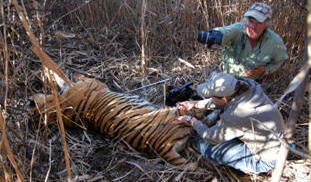
Africa? Captive lions in South AfricaHuman beings, through there intelligence and technological advances, choose to keep crippled, deformed and weak babies alive. Tigers have no such luxury, they are controlled by the laws of nature. Ironically, Runti's death helps ensure the survival of the other 4 cubs. Right now, because of the devastating floods, I have tigers born and raised wild, sitting in holding bomas, waiting patiently for me to fence and stock a new area so they can return to the wild. To keep these tigers in holding bomas, cost me R50,000 per year. I notice your E-mail doesn't offer to contribute financially to raising Runti in captivity. "Ratings rather than doing the right thing".
Rating are the last thing on my mind when recording the events as
they unfold. In fact when Runti was alive, I had no contract with
National Geographic. I have also been criticized for revealing the
mistakes made at Tiger Canyons. When I accidentally shot Tigress
Shadow in the foot, I had no need to expose the accident to you or
anybody else. I could have easily kept the death of Runti to myself.
Tiger Canyons is an experiment, it has successes and failures. I communicate the good, the bad and the ugly and I decided a long time ago, to be totally transparent. I am a one man band and I take the decisions in the best interest of the tigers as a group. From success we learn and from failure we learn even more. "I will not recommend you for causes and will never watch the programme again." This seems rather dramatic! Why don't you visit Tiger Canyons, see for yourself and then make a judgment call. However this newsletter is not about Runti, it is addressed to the hundreds of students, volunteers and young people requesting work at Tiger Canyons. Many of you are wanting to make careers in conservation. I say follow your dreams. Let me explain - Tiger Canyons is a one man show, it is an experiment. I have a tight band of local people who support me. I live in an old ramshackle house. There is no accommodation for volunteers. All my money is in the Tigers.
|
||||||||||||||||||||||||||||||||||||||||||||||||||||||||||||||||||||||||


|
|
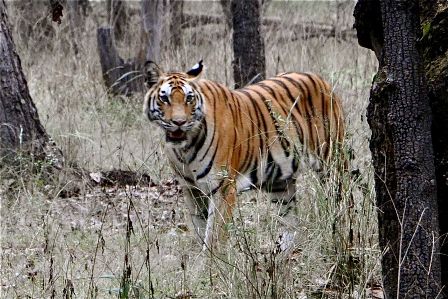
Wild Tigers I believe, belong to the world, not
just to the Asian countries that inherited them. I believe that wild
tigers are a planetary treasure and each and everyone of us on this
planet and our children should have the right to see a tiger in the
wilds.
 |
|
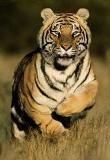
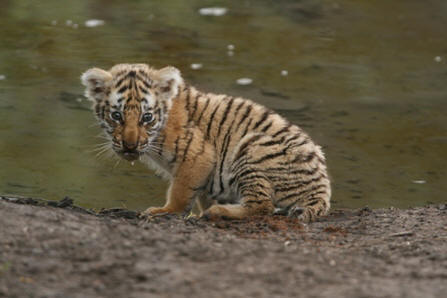
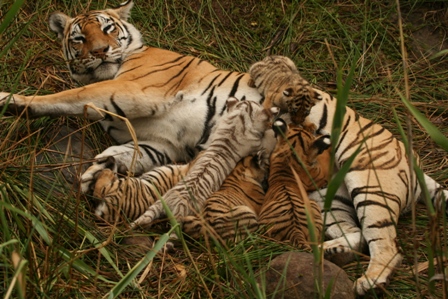
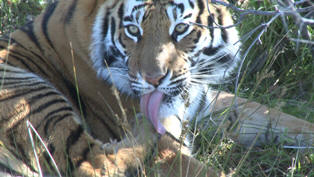
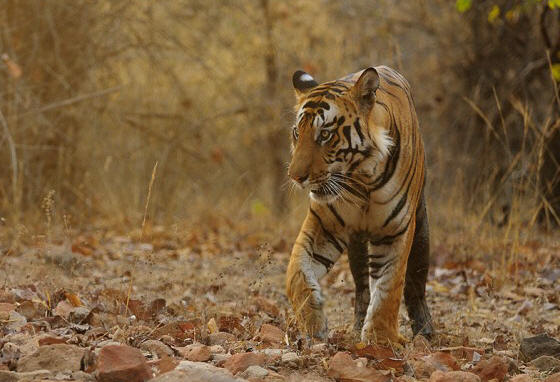
The Pictures have
been taken at Two Tiger reserve parks namely Bandhavgarh |
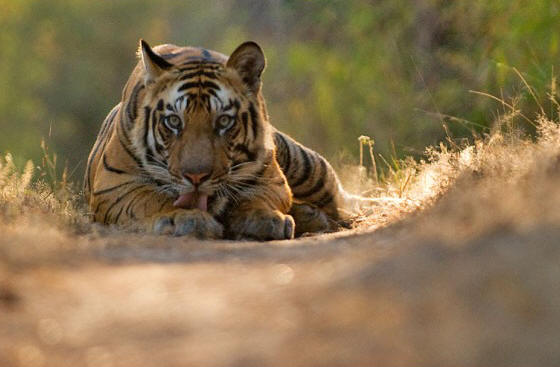
The world's human population has just passed through 7 billion and the wild tiger has declined to around 1000.
Many people now believe that the Asian countries
who inherited the wild tiger are incapable of saving them or
conserving them. This is where you, who are starting out on a
career in conservation, have opportunity.
|
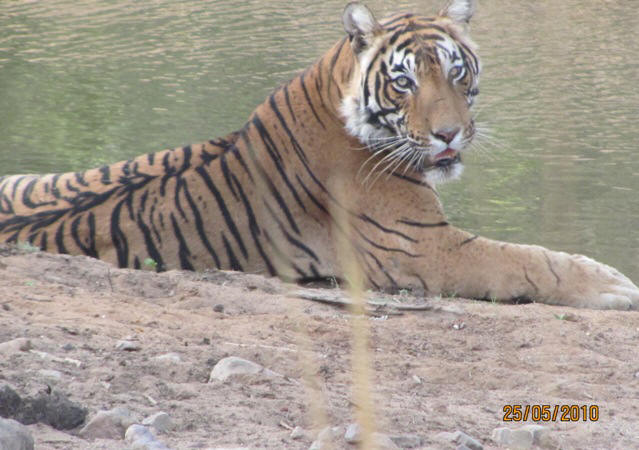
Lakshmi Mittal the Indian tycoon, is the fifth richest man in the world. He has acquired his wealth from steel, yet not a single tiger park in India is fenced. How is this possible?
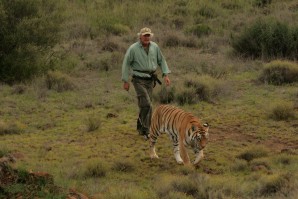
At the same time there are dozens of examples of parks in Africa which are fenced and successfully contain large cats like lion, leopard and cheetah. At Tiger Canyons we have successfully run tigers side by side with domestic stock by using electric fences.
When I ask the Indian authorities why they don't fence their parks, they say there is no budget. Yet India is spending billions of dollar an developing nuclear weapons. How is it that they can't find a budget to separate the human and the domestic stock from the tigers? Is war more important than saving a magnificent creature like the tiger?
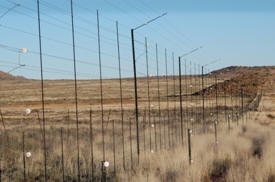
Electrical fence at Tiger Canyons
Perhaps you folks in India know Lakshmi Mittal or other wealthy influential businessmen. The future of the wild tiger is in your hands.
The tiger needs space which has suitable habitat, it needs suitable prey and protection from poachers, and domestic stock grazing into the unfenced parks. Therefore the first step is to get as many of the parks electrically fenced with a 3.3 meter barrier. Is it expensive? You bet it is!
The second step is to privatize the parks. Get them into the hands of private enterprise. Take the conservation of tigers out of the hands of the government. Follow the South African model where the private enterprise owns more wildlife than the South African government. It's the private enterprise that is expanding land for wildlife by 300,000 hectares per year in South Africa.
Therefore to all Indian people who correspond with me, I say study successful models elsewhere and then create pressure for change in India.
Hotel groups in India that rely on tourism, should be encouraged to acquire land which is fenced and stocked with suitable prey. Then the tigers can be introduced and controlled ecotourism developed. Once again South Africa has good examples in its private lodges.
Travel to Londolozi Game Reserve in South Africa and see how we allow only 3 jeeps at a time around the leopards sightings. In Indian parks, if a tiger is located, as many as 22 jeeps may crowd around the tiger. Tourism is then seen as a disadvantage to wild tigers instead of a benefit.
Viewing vehicle showing tourist leopard at Londolozi
For you conservation students that live outside Asia you have an even bigger role to play. If the wild tiger is not going to be saved in Asia where is it going to be saved?
Approach your local zoos and encourage them to acquire land for wild tigers. There is an estimated 45,000 tigers in captivity world wide. Encourage your zoos to do ex-situ conservation projects with wild tigers. Putting a tiger in a cage is "old think", encourage the zoos to go for wild populations of tigers.
Approach your national parks to create protected areas for wild tigers.
In short, you create populations of wild tigers in Australia, Africa, USA, Canada, anywhere where you can find space and suitable prey. To the many USA people who correspond with me, I say approach Ted Turner, he has vast tracts of land in New Mexico and Montana. Ted gave a $1billion to the United Nations.
There are many millionaires in the USA, try and influence them into investing in wild tiger populations. I have been on big ranches in Texas, some are very suitable for tiger sanctuaries.
In the world today, the rich people are getting richer and poor people are getting poorer. This is not a recipe for stability in the future. History has shown us that when war break out, wildlife disappears rapidly. Mozambique Vietnam, Sri Lanka, Cambodia, Korea, Zimbabwe, Uganda and Rwanda are all good examples of wild life being decimated during war time.
If India and Pakistan end up at war with each other, as seems inevitable, where will the tiger be? The tigers is a big bodied predator that needs space, habitat, prey and protection from human beings. When human beings start killing each other, the chances of humans protecting the last tigers are nil. The tiger already competes with 320 people per square kilometer in India, a war scenario would be disastrous for the tiger and its habitat.
Therefore I say the more wild tiger populations that are created outside Asia, the better. Tiger Canyons has done much of the initial research. We have a road map to create these ex-situ conservation sanctuaries. The information is freely available and we have wild tigers ready for relocation.
To you students, conservationist, dreamers, innovators, visionaries, writers, poets, musicians around the world, look to create tiger sanctuaries for wild tigers in your own countries, this is the most valuable role you can play.
Try to be the most effective where you can and that is in your own countries. Use Tiger Canyons as the springboard to launch your projects, I will travel to help you when you have a suitable sites and resources to make it happen.
Never believe that you cannot achieve it. "First dream, then communicate, then plan and finally execute. Vision, attitude, tenacity, enthusiasm and youth are your biggest allies." Good luck to you all.
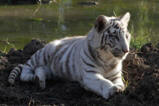
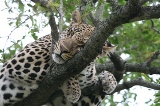
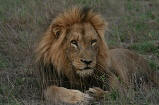
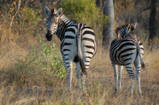
Tiger Canyons is offering the following competition to tiger supporters and photographers:
-
The best picture of a tiger, or tigress or lioness Savannah taken at Tiger Canyons, will win a Big Cat Safari for 2 people sharing. Value R120 000
 |
 |
 |
 |
 |
 |
 |
 |
 |
 |
 |
 |
Londolozi and Tiger Canyons
A Big Cat Safari is 3 nights at Londolozi Game Reserve and 3 nights at Tiger Canyons. It does not include travel to and from Londolozi and Tiger Canyons respectively.
Not more than 3 pictures per person may be entered and entries close on 30th September 2011.
All pictures should be captioned and in the case of a non-adult, the age of the photographer should be stated.
-
The picture rated second by the judges, wins two nights at Tiger Canyons for two people sharing. Value R15 000. Excludes travel to Tiger Canyons.
-
The picture rated third by the judges, wins one night at Tiger Canyons for 2 people. Value R8 000.
-
The picture rated fourth, gets one lined bound signed copy of Nine Lives. Value R5 000
-
The picture rated 5th, gets one signed copy of Nine Lives. Value R300
The judges of the competition, will be well known photographers, Daryl and Sharna Balfour and their decision shall be final.
Tiger Canyons has the rights to make 30 limited copies of the picture which wins first prize, to be sold to raise funds for Tiger Conservation. All costs of the 30 prints to be incurred by Tiger Canyons.
Tiger Canyons has the rights to make 20 prints of the 2nd, 3rd, 4th and 5th best pictures selected to be sold to raise money for Tiger Conservation. All expenses in creating these prints is for Tiger Canyons' expense.
I urge everyone, young and old, to join into the spirit of this competition and let's let our images speak across the world.
Pictures should be emailed to [email protected], closing date 30th September 2011. Your name, e-mail, cell phone number and country where you reside, should accompany your entry pictures. Resize your images to 150 KB before you email them (we don't have 3G). A short list will be made from the entries received and these participants will be requested to send their images in high resolution.
For the months of June and July, Tiger Canyons is offering the chance for guests to hunt with tigress Julie and tigress Zaria.
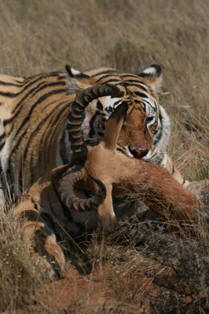
Julie with kill
Hunting will be down the rugged tiger canyon and unfit or infirm people are advised not to participate. Hunting with tigers in this terrain is not for the faint hearted.
Children under 16 will not be allowed.
Contact Sunette: [email protected]
Many people having seen "Tiger Man of Africa", have been inspired to offer donations to the project.
Many people across the world have inquired why I do not have a tiger foundation to which they can donate funds.
The answer lies in the fact that to create a foundation is costly and time consuming. Trustees need to be appointed to administer the foundation. I often find that the money gets spent on the admin rather than the tigers.
Therefore over the years I have tried to keep it simple. After the devastating floods, I created the Savannah Fund in memory of the lioness lost in the chaos.
If anyone would like to donate to the Savannah
Fund, the donation would be most welcome and I will guarantee that
the funds go straight into tiger conservation.
www.jvbigcats.co.za/savannahfund.htm
SEVEN FALLS
TRADING (PTY)
LTD
FIRST NATIONAL
BANK -
TROMPSBURG
A/C 62094732693
BRANCH CODE:
230932
SWIFT CODE:
FIRNZAJJ
IBAN: 230932
62094732693
First National
Bank
32 Church Street
TROMPSBURG
9913
SOUTH AFRICA
I am continually amazed and gratified at the concern for the wild tiger worldwide.
Tread lightly
JV

Tread lightly on the Earth
[email protected]
Copyright 2007 @jvbigcats All rights reserved
|
|
||
|
|
Newsletters 162
|
|
|
|
||